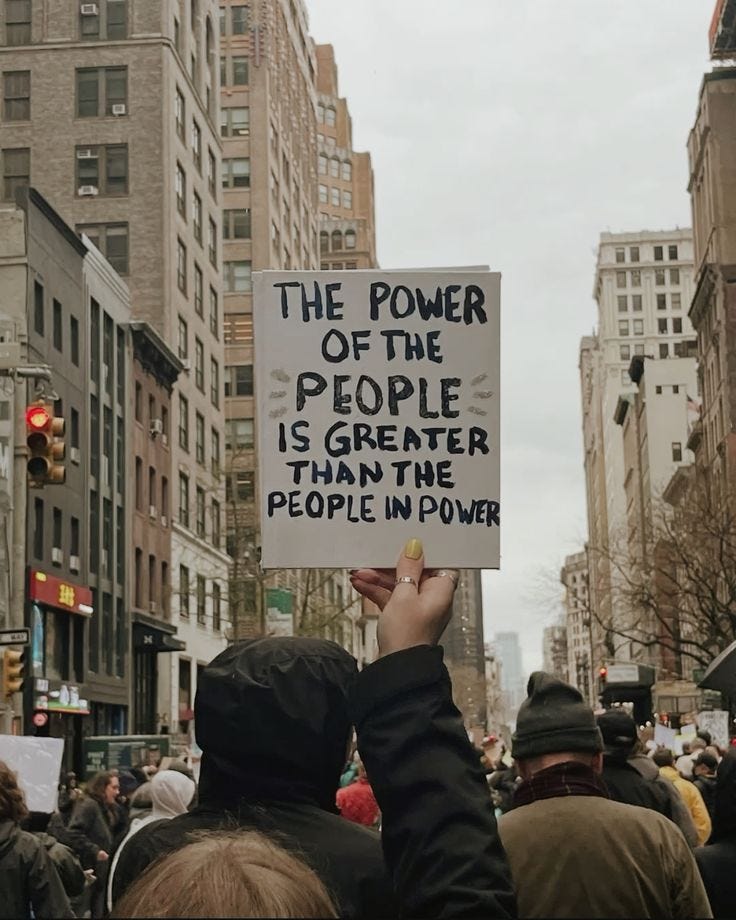
This past weekend revealed the violent murderous acts ICE enacts on people in the name of protecting the border, but what is really an effort to reaffirm white supremacy in the US and immobilize the power of the people. This is a fight for all of us. And it’s important to know our organizations - assuming you work within one - can be implicated. The current government will continue to classify organizations connected to protestors as engaging in domestic terrorism to go after their funders and staff. That’s just one tactic; there are others. If you’re running a social justice nonprofit, here’s what’s happening and why it matters:
They’re Looking at Your Foreign Connections
A presidential memo (NSPM-7) directs federal agencies to investigate nonprofits with international ties for potential Foreign Agents Registration Act violations. Got overseas partners or funding from abroad? You’re likely on their radar.
Grant Funds Are Under the Microscope
The feds are investigating whether organizations use federal grant money for lobbying. Even if you’re careful about separating advocacy from grant-funded work, expect questions.
IRS Enforcement Is Ramping Up
Changes at the IRS could make it easier to pursue criminal tax enforcement. Any gray areas in your tax-exempt status could become problems fast.
They’re Going After Nonprofit Funders and Staff
Here’s the scary part: NSPM-7 explicitly targets “funders, officers and employees” of organizations under investigation. This isn’t just about your org—it’s about the people who fund you and work for you personally.
States Are Piling on
Some state AGs are aggressively enforcing charitable registration rules, so you’re dealing with pressure from multiple directions.
What You Can Do
Check if FARA applies to you. Audit how you’re using grant money. Make sure your compliance paperwork is bulletproof. Know who’s funding you. Get your state registrations in order everywhere you operate. And seriously consider talking to a lawyer about your specific situation.
Bottom line: They’re using regulatory tools to put pressure on organizing and advocacy work that will protect the ideals of an inclusive democracy, fight state violence and suppression, and address current and historical injustices.

Today’s article is the third of a three-part series with my colleague and friend Patty Narváez-Wheeler, Founder and Managing Director of Práctica Consulting. Throughout my years working and learning from Patty, I’ve seen how masterful she is in team development toward equity and systems change. I’m honored she has agreed to share some insights on questions I have about how to lead teams in a moment that is rightfully scary, overwhelming, and unprecedented for nonprofits.
Jordan: Many organizations and public agencies have been threatened with losing funding if they don’t end JEDI-focused initiatives, and some have given in to these pressures—at least on the surface. Some have stripped JEDI-related terminology from their policies and communications but insist they will continue to live out the values nonetheless. Realistically, can an organization be effective in improving internal justice, equity, and inclusion without naming it?
Patty Narváez-Wheeler: The most straightforward answer is: “yes… but it depends.” Words matter, but not as much as action—and today’s environment complicates that common-sense truth. In my experience, the core ingredients that make JEDI work successful are consistent: grounding in employee and community voice or data; adequate resourcing; executive backing; accountability structures; and a clear power analysis. These elements can be measured both individually and collectively. The name of the initiative or the glossary of terms has never been on that list.
However, as you noted, this administration hasn’t only harmed the work rhetorically; it has threatened funding. So the real question becomes about exposure and risk tolerance in this new landscape which includes your own positionality as a leader (how supported and trusted are you) and your organization’s positionality (are there genuine legal or funding risks?). And I want to take a moment to say we need to extend grace to leaders right now, because we are not all experiencing this moment the same way.
And extending grace does not mean accepting the whitewashing of history or centering fragility. It is absolutely limiting and, at times, even harmful when we’re pressured to dilute or censor the accurate, specific terminology required to name things clearly. But even pre-Trump era, I’ve seen the “right” terms weaponized, brilliant anti-oppressive analysis never mature into impact, and seen groups spend months discussing terminology instead of building momentum.
We absolutely need precise language to anchor our analysis—and the work is stronger when a workforce shares that understanding. But language alone has never been what moves systems. It’s the practice behind the words that creates real change.
The pressures are mission-specific and region-specific. For many, this isn’t about a lack of courage; it’s about organizational survival and the impact a funding loss could have on the communities they serve.
So my first piece of advice is: do not make this decision in isolation. Lean on internal and external SMEs to assess real risks—legal, programmatic, financial, and relational. And as reluctant as we may be, we also need to honestly engage with current critiques of DEI while reviewing our own feedback and impact data to see whether anything meaningful or constructive emerges. Sometimes there is.
Second: follow where that process leads. Recently, I supported a partner organization through this discernment process. Because of their positionality, we clarified that their strategy needed to be legally defensible, not risk-averse, given no actual funding threats and layers of executive protection. In other organizations, the risks are very real. If your assessment indicates substantive legal or funding exposure, you may have to make language changes. If you do, be transparent about how you arrived at the decision and commit to tracking the impact. In uncharted territory, leaders must prioritize living into their values in how decisions are made, not just what decisions are made. This allows us to maintain integrity and accountability while navigating tough calls.
And if your work or organization is not at real risk? Then stay the course. Consistency supports morale, maintains trust, and strengthens the broader ecosystem’s ability to push back against harmful narratives coming out of the Trump administration.
I’ll end with this: Regardless of which fork you choose in the road, there is language clean-up work to be done. Whether we like it or not, terms like “social justice,” “woke,” and “DEI” have entered mainstream culture in ways that lack historical grounding, facilitated dialogue, or lived experience; the very ingredients that allowed many of us to deepen our understanding of these concepts in our own consciousness-raising journeys.
So now is the time to clarify meaning. Define what you mean when you use certain terms—old or new—in plain language. Give concrete examples of what those values look like in practice, with clear dotted lines to not just values but mission, performance, compliance, and impact (because not everyone in a workplace is compelled purely by values). In this landscape, I think our job is to embody our values in the process, provide linguistic clarity to cut through ambiguity and fear, and keep moving the work forward in whatever way is possible and principled.
Jordan: Thank you for that thoughtful response, very helpful! Last question - What are some book or podcast recommendations you can offer to nonprofit org team leaders to help guide them through these kinds of challenges?
Patty Narváez-Wheeler: Just this week on “Work Life with Adam Grant”, I heard a phenomenal conversation between organizational development psychologist Adam Grant and leadership experts discussing a concept called ‘hyper normalization’ –and the dangers of toxic productivity culture and a better way of getting things done. Fantastic for whole teams to listen to and discuss insights for this particular overwhelming and change-driven moment in our professional lives.
Jordan: You’ve sent me his stuff before, and it’s really good. I recently subscribed to his pod. What else?
Patty Narváez-Wheeler:
Values Exercise for Teams: We talk a lot about “living into our values”—many of us in leadership do. But recently, while facilitating a conversation with a group of frontline and program staff, someone pulled me aside afterward to say thank you for raising the question of values. She admitted she had never actually dug into her own before and asked for a resource.
I shared one of my favorites: social worker and researcher Brené Brown’s Living Into Our Values worksheet. It’s practical, insightful, and a powerful tool for unearthing and discussing our values—and how they show up in our work. Exploring this together can be a meaningful bonding and team-building experience.
I’ve used this with my own diverse teams, and other leaders have shared how powerful it was for theirs as well. The Racial Healing Handbook by Anneliese Singh, PhD, offers a thoughtful way to share our lived experiences with one another in a way that bonds us through healing—not through trauma. I find this book helps teams do exactly that. (Tip: start at the beginning; don’t skip ahead to the later chapters, even if you feel well-versed in these topics.)
Jordan: It’s really hard for me not to skip ahead, but I’ll try :) Thanks for the really thoughtful conversation Patty. Let’s do this again sometime.

T Mobile Hometown Grant - Get up to $50,000 to bring your community project idea to life. - March 31, 2026
West Virginia Rivers Community Action Mini-Grant Program - supports communities growing collective power to influence decision makers and secure safe, healthy water for all. Mar 15, 2026
Montclair Fund for Women’s grant awards - Supporting education and social justice and focusing on women of color. - Mar 6, 2026.
Meyer Memorial Trust - Addressing Trauma and Healing for Black Communities in Oregon / Justice Oregon for Black Lives - March 3, 2026
Philadelphia Area Racial Equity Grants - Offered by the Nelson Foundation. - Mar 1, 2026
Grants to Address Mental Health in Criminal Justice System - Sydney R. Baer Jr. Foundation provides grants in this area to nonprofit organizations. - Mar 1, 2026
Frank Hadley & Cornelia Ginn Foundation - education programs that support academic success, social-emotional growth. - Mar 1, 2026
The Ben & Jerry’s Foundation Social Justice Organizing Grant Program supports grassroots organizations with budgets less than $350K - Feb 18, 2026
The Roblee Foundation - funding requests in race, ethnicity, and gender equity. - Feb 17, 2026
Black, Indigenous, and People of Color Fund -offers competitive grant programs to reflect community needs and the foundation’s strategic initiatives - Feb. 14, 2026

Harvard Health Coverage Fellowship - rolling deadline
Leadership Fellows at The Trust - ensure that tomorrow’s nonprofit organizations have the human capital to flourish - March 2026 through June 2026
The Civic Bridgers Fellowship - immerses emerging professionals in a year of service at a nonprofit or public agency. - May 29, 2026
Google Creative Fellowship -places emerging talent on dedicated creative teams at Google - March 9th, 2026
Sundance Ignite x Adobe Fellowship - supports emerging filmmakers ages 18 to 25 - Feb 12, 2026

Check out our 2026 Book Chats!

Siobhana McEwen on Growing a Grassroots Group on the Outskirts of Portland
Siobhana McEwen from the Southwest Washington Equity Coalition discusses racial justice organizing in suburban communities. She shares how her organization grew during the 2020 uprising, addressing advocacy and policy needs for people of color and immigrants in the Portland metro region, and explores grassroots activism, nonprofit leadership challenges, and community collaboration.
Subscribe and Listen Now on Your Favorite Streaming Platform: Spotify | Apple Podcasts | YouTube |